28 May 2008

Either you're VIN or you're OUT

I'm Out... and can't get VIN.

Ok, so for those who don't know, VIN is the Veterinary Information Network. It's been around since 1991 to service the vet industry and their support personnel. It's a database jammed packed with information, chat logs, educational and clinical information... and has a searchable dB of documents.

I have a vet within my family. I've asked if they would log in and search for articles on Ketamine, or if they'd allow me to do a search. When I explained why I wanted access my request was ignored. That's been several weeks ago and I am still steaming over it. It feels a bit like a conspiracy of sorts. There is a definite unwillingness to go against the grain, go against other vets, go against typical, usual protocol.

I asked a vet recently if they had any idea why the vet we used with Gimli - or their vet techs that they relied on to talk to owners - did not, in any way, suggest an alternative to Ketamine. I asked the clinic we used about an alternative fifty different ways and was met with the same answer. There wasn't an alternative... which is a falsehood. As many readers or "owners" of pets may also do, I had a list of questions that I asked prior to committing to the dental procedure.

Here are the questions I asked:
  • What is the process, and are there any risks?
  • Is there other alternative to sedation? And is your sedation considered safe?
  • Can you use a constraining blanket rather than “twilight” sedation?
  • Are there other options to a sedated dental that can be done at home?
  • Has your clinic EVER lost a patient during a dental?
  • Will a blood test and light physical be done prior to the procedure?
And, here are the answers I received (yes, I logged my phone call with the vet tech):
  • the risks were low
  • no other alternative was available or suggested in regards to the anesthesia
  • a constraining apparatus could not be used
  • “twilight” sedation meant that the patient would “barely be under”
  • the clinic had NEVER lost a patient.
Why was Isoflurane or Sevoflurane not suggested? (By the way, readers, Haloflurane is a Ketamine derivative, so steer clear).
Vets know and use gas as an alternative to injectible anesthesia, it's not uncommon or odd to ask for alternate induction agents. Here's what one vet said - and I'm paraphrasing:

"...Most vet clinics have a standard protocol that they follow for surgical procedures. The staff, vet tech, and doctors all know the standard protocol extrememly well. When something outside this standard is used it causes the vet, vet techs, and staff more time and energy because they are not as familiar with it..."

Therefore, this vet concluded that an alternative was not offered to me because it would have caused that particular vet and clinic to go outside their "norm".

That... is NOT acceptable.


26 May 2008

Why it's important to learn and empower ourselves

Rosie Rosebud
Rose relaxes


Junipurr Lily
Lily loves BG (Granddaddy)


Bilbo Bombadil
Bilbo


And for our sweet lost boy, Gimmie. who so loved his life:
Where's the cat in the water, Mommie?

Ketamine References: the buzz is out, isn't it?


There are many articles available via the Internet, written by vets or scientists, which raise serious concerns over the use of the very common and very cheap induction agent, Ketamine. Research substantiating this was conducted in the early 1990’s by Dr. Michel Houard, of Chambourcy, France, and specifically states if Ketamine is used on Devons, Cornish, Germans, Selkirks, and Sphynx, it will cause death.

What's important to note for Devon and Sphynx owners is that within THESE breeds this drug can do one of three things:

1. Cause non-diagnosed cardiomyopathy (HCM) in a cat to progress
2. Due to the drug lowering the *heart rate, it can cause a cat to go into congestive heart failure (CHF)
3. Advance an undiagnosed HCM so that another dose of Ketamine may cause death

What is Ketamine?
Ketamine is a widely used dissociative drug. It has a noted history of causing an increase in blood pressure, a rough recovery, and, as is referenced in numerous resources, can cause cardiac arrest leading to congestive heart failure in breeds – particularly those that may have the spasticity gene.
Ketamine is commonly used as an induction agent for children and the elderly, and is noted on the US Drug Enforcement Agency.

What does "dissociative" mean?

A dissociative is a drug which reduces (or blocks) signals to the conscious mind from other parts of the brain, typically, but not necessarily, limited to the senses.

Ketamine as a street drug - vet clinics beware: -- resourced from DEA (US Drug Enforcement Agency)

Street terms for Ketamine: jet, super acid, Special "K", green, K, cat Valium.
Ketamine comes in a clear liquid and a white or off-white powder form.
Ketamine is a tranquilizer most commonly used on animals. The liquid form can be injected, consumed in drinks, or added to smokable materials. The powder form can be used for injection when dissolved.


In certain areas, Ketamine is being injected intramuscularly.
Ketamine, along with the other "club drugs," has become popular among teens and young adults at dance clubs and "raves."

It is marketed as a dissociative general anesthetic for human and veterinary use, the only known source of Ketamine is via diversion of pharmaceutical products.
Recent press reports indicate that a significant number of veterinary clinics are being robbed specifically for their Ketamine stock.
DEA reporting indicates that a major source of Ketamine in the United States is product diverted from pharmacies in Mexico. Prices average $20 to $25 per dosage unit.
Higher doses produce an effect referred to as "K-Hole," an "out of body," or "near-death" experience.
Use of the drug can cause delirium, amnesia, depression, and long-term memory and cognitive difficulties. Due to its dissociative effect, it is reportedly used as a date-rape drug.


Scientific/Medical: -- resourced from Wikipedia
Ketamine is a drug for use in human and veterinary medicine developed by Parke-Davis (today a part of Pfizer) in 1962. Its hydrochloride salt is sold as Ketanest, Ketaset, and Ketalar. Pharmacologically, ketamine is classified as an NMDA receptor antagonist, and at high, fully anesthetic level doses, ketamine has also been found to bind to opioid μ receptors and sigma receptors. Like other drugs of this class such as tiletamine and phencyclidine (PCP), it induces a state referred to as "dissociative anesthesia" and is used as a recreational drug.

From PUBMED:
Ketamine Death
http://www.pubmedcentral.nih.gov/pagerender.fcgi?artid=1481214&pageindex=4#page


-----------------------------------------------------------------------------

There are numerous other anesthesias that your vet should be aware of, and suggest as an alternative if that question is raised. Many of these are non-dissociative and do not cause an increase in blood pressure and do not have the rough recovery that is noted over and again with Ketamine, or Ketamine derivitives such as Telazol and the gas Haloflurane.

Isoflurane or Sevoflurane are extremely common examples of gases that can be used instead of Ketamine or like agents.

Please note: Anesthetics agents increasing the risk for death in Rex and Sphynx are:
- Dissociative: Ketamine (Imalgene®, Clorketam®, Zoletil®)
- Volatile: Halothane


Reference:
Dr. Mike Richards, DVM – Cobbs Creek, VA Matthews Veterinary Clinic

“Ketamine causes hypertension during anesthetic recovery and it is possible that the detrimental effects attributed to Ketamine may be due primarily to cases of undiagnosed cardiomyopathy in cats undergoing anesthetic procedures. These cats would be especially sensitive to hypertension and the increase in blood pressure induced by Ketamine is supposed to be pretty significant in some cats.”

Additionally he wrote:
“For a long time I have heard reports of episodes of pulmonary edema and/or heart failure following anesthesia in cats. There has been some concern among veterinarians over the potential for Ketamine, a commonly used anesthetic agent, to cause episodes of pulmonary edema. Ketamine appears to cause hypertension during the recovery period in many cats. If the cat has pre-existing cardiomyopathy this could lead to a sudden worsening of the cardiomyopathy leading to pulmonary edema and death, if the cardiomyopathy cannot be brought under control with medications. There is some possibility that this effect could occur even without cardiomyopathy being present. I have only seen reports of this condition in association with Ketamine but it may occur with other anesthetic agents".

NOTE: I located Dr. Richards at his vet clinic in Cobbs Creek, Virginia, and phoned his office. He suggested that I read over available articles on this subject at PubMed.org for citable references.

Reference:

PUBMED

http://www.pubmedcentral.nih.gov/pagerender.fcgi?artid=1255390&pageindex=1#page http://www.pubmedcentral.nih.gov/pagerender.fcgi?artid=1255390&pageindex=2#page http://www.pubmedcentral.nih.gov/pagerender.fcgi?artid=1255390&pageindex=3#page
http://www.pubmedcentral.nih.gov/pagerender.fcgi?artid=1255390&pageindex=4#page


Reference:

On the risks of anesthesia - even when your vet tells you that it's safe:

Feline Anesthesia in the New Millennium—SOTAL

State of the Art Lecture
Dr. Jan Ilkiw
Diplomat, ACVIM (Anethesiology)
Professor, Department of Surgical and Radiological Sciences, University of California, Davis.


EXCERPT – full lecture at this link


The last and most recent study included all species and reported techniques and concerns, rather than complications and morbidity. While castration and ovariohysterectomy were the most commonly performed procedures requiring anesthesia in cats (together 54%), dentistry accounted for 22% of cats requiring anesthesia. Intubation was carried out in cats by 76% of practitioners and all small animal practitioners used inhalants for maintenance.
These studies indicate the significant risks and mortality associated with anesthesia in cats, especially if they are ASA category 3-5. The use of inhalants for maintenance of anesthesia in veterinary practice is frequent and the most commonly reported complications relate to intubation and respiratory arrest. While halothane was the mainstay of inhalant anesthesia in these studies, Isoflourane is now probably the most commonly administered inhalant. In veterinary practice, the use of monitoring equipment that is likely to warn of impending complications is rare. In those patients that were monitored appropriately, hypotension was the most frequent complication.


Information will be added to this post as gathered and verified. The goal is to encourage the drug companies that produce Ketamine for veterinary use to include a warning on the label for exotics breeds.

The smaller picture is to have breeders, owners, and vets be provided legitimate, verifed information regarding Ketamine and potential deaths of felines in the exotics breed.

22 May 2008

The quest to contact Dr. Houard... are we closing in?

I contacted the vet cardiologist that kindly translated the French article on Ketamine and asked if she would consider phoning Paris and speaking directly to Dr. Houard. She has agreed to do that. Thankful am I for the kindness of true animal lovers like Dr. Straeter-Knowlen.


UPDATE: In what I felt was a rather polite but political reply, I received a stiff "NO" from the Association of American Wives of Europeans regarding my email to them asking if someone would kindly give my contact information and inquiry to Dr. Houard - whose street address is near to their association office. Votre manque de bienveillance décevait.

20 May 2008

Another milestone

Thanks again to Britt Swartz for coming through with an address and telephone for Dr. Houard.

Like most treasure hunts - finding and communicating with Dr. Houard being the prize in this instance - the hunt is fraught with excitement and frustration.

I need to find the following:

--- an email address for Dr. Houard
--- the name of his business or practice (hopefully he's still working with animals)
--- someone willing to speak to him on my behalf that is fluent in French

My next step will be in recontacting some of the people I've relied on recently. The problem with asking for favors of busy people is that one runs the risk of losing a connection. I'm hoping that won't be the case. I have been slightly pushy in regards to getting and gathering up information. It's a compulsion for me and my rush to find information often doesn't play into other people's time schedules.
So far, though, everyone has been very kind and patient with me. (thank you patient people)

It's early yet this morning and too soon to try to call my contacts who might help with this *new* request.

I located an association on the Internet that I have contacted for help; the
Association of American Wives of Europeans. This organization is located in Paris and, as the name implies, is American women married to Europeans and living long-term there. I've asked if someone at this association would be willing to track down the address and telephone number and send me back a business name, website address, or hopefully be willing to call the number and give my information to this office (or whatever type of facility it is).


It's a great start to the day. At least the good doctor is still living in France.

16 May 2008

Burning the Midnight Oil

I have sat here at the computer from 10 PM last evening until this very moment trying to track down Dr. Michel Houard, of France (or he WAS at some point). So far I'm hitting dead-ends.

I have his document translated into English - thanks to the efforts of kind people - but without validation it doesn't have the impact that it justly deserves.

I'm positive that this paper was published in some journal - maybe as a scientific research Abstract? I don't have access to online vet journals or scientific information... but there must be a way to find this veterinarian. Even if he is deceased he left a footprint somewhere.

Dr. Houard... where are you?

15 May 2008

Silver Ferns and Golden Friends

I've had so much support over the past month. Gimli's death was a crushing blow to me, inparticularly, and for my husband as well. It's been just like a person's death... to US... and I realize that some people may not understand that emotion.
Last evening... perhaps because I'm so wound up with this Ketamine quest... I had another emotional moment where tears wouldn't stop flowing. I miss that little boy so much. Channeling my feelings into trying to make his death meaningful has helped, but it doesn't stop the missing or doesn't fill the spot in our home.

Today, still feeling alittle blue, I had a set-back on my attempts to find an attorney to represent us with the vet. He wanted $800 to write a letter on our behalf - so back to the drawing board there.


But friends... what would we do without them?
Today an artist friend of mine, who knows how we feel about New Zealand (avidly wish to live there) and understands how it makes me feel (uplifted / hopeful) to *think* about someday making it to that Land of the Long White Cloud, gifted me with a sculptural piece she created of the silver fern - a symbol of Zed.

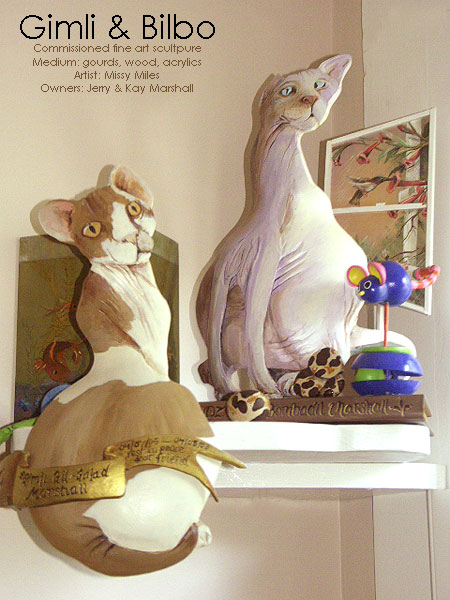
She told me that the piece started out as the base of a memorial Fine Art gourd I commissioned her to do of Bilbo and Gimli together. Then, it morphed into the Silver Fern. We talked alittle yesterday about Bilbo and Gimli's names. Why I named them after Lord of the Rings characters, and I talked about the Maori tribes, the Haka, and other NZ related chatter.
Her gift is not only timely as an uplifting gift of loving friendship, but it gives me a tangible symbol of a place I long to visit, or immigrate to... something for Hope, something for Dreams. Something positive on a blue day.
Her name is Missy Miles, and her art can be seen online at Organic Vessels.